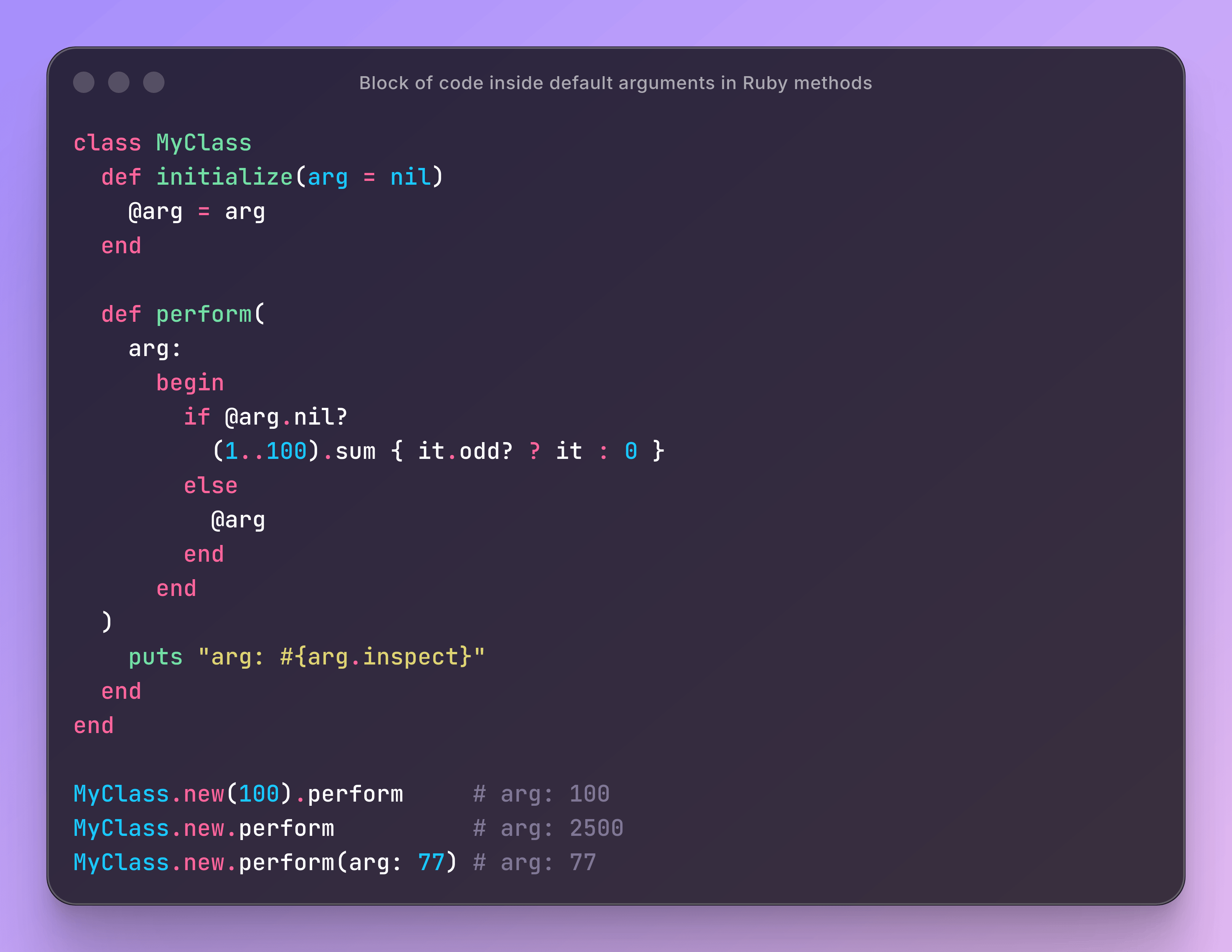
Following up on my previous post (where I showed how to set default values in Ruby methods), it turns out you can write not just a single expression on the right side, but an entire block of code inside a begin-end construct. Of course, I’m not sure if you should use this in production, as it might cause some unpredictable side effects. Still, this is valid Ruby syntax. And if you want to become a experienced developer, knowing these nuances is definitely worth it.
class MyClass
  def initialize(arg = nil)
    @arg = arg
  end

  def perform(
    arg:
      begin
        if @arg.nil?
          (1..100).sum { it.odd? ? it : 0 }
        else
          @arg
        end
      end
  )
    puts "arg: #{arg.inspect}"
  end
end

MyClass.new(100).perform     # arg: 100
MyClass.new.perform          # arg: 2500
MyClass.new.perform(arg: 77) # arg: 77